Introduction
Anatomy
Cause
Symptoms
Types of bone fracture
Diagnosis
Non-surgical treatment
Surgical treatment
Rehabilitation
Prevention
Introduction
Bone is often misunderstood as a non-living organ. Quite the contrary. It is a living tissue that constantly regenerates itself through metabolism. There are more than 200 pieces of bones in the body, which make up about 20% of the body’s total weight. The central axis is made up of the skull, spine, ribs and pelvis. The upper and lower limbs are made of long bones attached to the trunk and placed evenly on two sides.
Anatomy
1. Chemical structure of bones
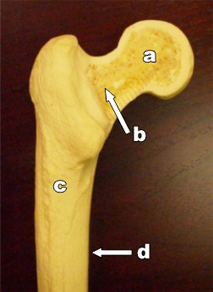
The bone is made up of three layers – periosteum, osteon and spongy bone. The periosteum layer is the outermost layer of soft tissues, which contains blood vessels and nerves that supply nourishment to the bone. They also contain osteoblast – bone cells capable of regenerating and repairing themselves in case the bone is injured or fractured.
Underneath the periosteum is the osteon, or better known as compact bone, which is responsible for maintaining the shape and form of the bone. The osteon envelops the spongy bone while the centre of the bone is the bone marrow cavity, which contains numerous blood vessels. Bone marrow has the capability to manufacture blood, which is why children’s blood marrows are red. When a person ages, the bone marrow’s ability to produce blood gradually reduces, so that when a person reaches old age, the bone marrow mainly contains fat and looks yellowish. However, in the spongy bone layer found in the two ends of a long bone and a flat bone, the bone marrow is capable of producing blood and is red throughout one’s life span.
The bone is made up of organic and inorganic materials. The main component of the organic material is protein, which gives the bone a certain softness and elasticity. The inorganic material is made up of calcium and phosphorous to ensure hardness of the bone.
The proportion of organic and inorganic materials varies according to age. Among children and teenagers, the organic content is relatively higher than that in adults. Therefore their bones are more flexible and elastic. The two ends of long bones in growing children are growth plates that are capable of elongating the bones. Among old people, however, the inorganic content is relatively higher, therefore their bones are harder and more brittle, hence more prone to fractures.
2. Function of bones
• Protection:bones can protect major organs, for example, the skull protects the brain, the rib cage protects the heart and lungs, and the spine protects the central nervous system.
• Support:bones make up a framework that keeps the body upright and supports its posture.
• Movement:bones, muscles, ligaments and joints work together to enable movements.
• Blood production:the bone marrow and spongy part of the long bones are capable of manufacturing blood cells.
• Storage of nutrients:important minerals such as calcium and phosphorous are stored in bones.
Cause
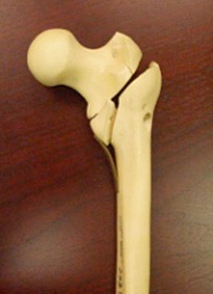
A bone can be fractured when it has received direct or indirect physical impact. Although bones seem rigid, they are, to a certain degree, pliable, flexible and elastic. It can “bend” somewhat when an external force is applied to them, For example, when you fall with the wrist hitting the ground, the bone temporarily absorbs the shock by “giving”, or changing its shape, slightly. When the external force is dissipated, the bone will return to its original shape and position. But if the external force exceeds what the bone can tolerate, it will break. As a person ages, the proportion of soft bones to compact bones in the body decreases. In addition, the density of the osteon gradually decreases, so that the bone becomes more brittle and prone to fractures.
The most common causes of bone fractures are traumatic injuries. Other causes include:
• Stress fracture: caused by repeated pressure on a particular bone. For example, strenuous training among marathon runners and military officers could cause stress fractures of their metatarsal bones.
• Pathological fracture: some diseases may damage the bone structure itself so that when a tiny external force is exerted on the bone, it gets fractured. Such diseases include congenital bone abscess, cancerous cells that have spread to the bones, congenital underdevelopment of bones, benign bone tumor and bursas, serious calcium deficiency and others.
Symptoms
• Pain and tenderness
• Swelling and bruising of soft tissues
• Deformity of limbs or joints
• Decreased range of motion
Types of bone fracture
There are two types of fractures – closed fractures and open fractures.
• Closed fractures, or simple fractures, occur in an enclosed space without contact with air and hence the chances of infection are low.
• Open fractures, or complex fractures – occur in conditions where there is contact with air and hence there is a risk of bacteria infection. Antibiotics are usually administered in this case.
Diagnosis
If someone is suspected to have a bone fracture, what should you do?
• Observe the patient to see if he or she is breathing, conscious and able to move the limbs freely. If there is any doubt, call emergency service for help. If you have first aid training, try cardio-pulmonary resuscitation in case the patient is unconscious.
• If the patient has serious pain in the head, neck and back, the skull or spine could have been injured. Do not move the patient.
• When the patient’s conditions have stabilised, try to use an elongated object such as a tree branch, wooden plank or long rod and wrap it around the injured extremity.
• If there is a wound, wash it with water and cover it with a clean cloth. Elevate the injured limb to reduce swelling and pain. Send the patient to the emergency room as soon as possible.
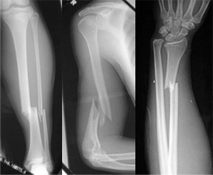
• Once at the hospital, the doctor will obtain a medical history of the patient and perform a thorough physical exam. X-ray is usually employed as a diagnostic tool. In the case of bone fractures in children, it is often necessary to take an X-ray of the opposite limb for comparison purposes. If necessary, other diagnostic tools can also be used, such as CT, Tc-HIDA or MRI scan.
Non-surgical treatment
• Restoring:for closed fractures, local anesthesia will be injected at the point of fracture. The orthopaedic surgeon will manually reposition the fractured parts into their original positions. This is known as “closed reduction”. Sometimes in long bone fractures, traction devices, such as a pin inserted into the bone or a bandage attached to the skin of a leg, can help to restore the alignment of the broken bone.
• Stabilisation:Stabilisation: if the fracture is not displaced or successfully reduced by closed method, it can be immobilised with plaster of Paris or a splint. Occasionally, traction may be used to stabilise long bone fractures.
• Analgesics is prescribed for pain control.
• Electromagnetic pulse therapy and ultrasound are used to promote fracture healing.
• Exercises of the muscles and mobilisation exercises of the joints of the affected limb are mandatory.
Surgical treatment
• For more complicated closed and open fractures, surgical exposure of the fracture site and reduction with a clear view of the bone fragments performed under general or local anesthesia is required.
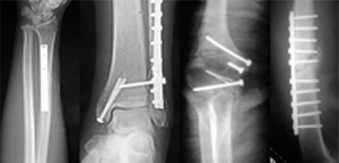
• Stabilising:the affected bone will be stabilised with either screws, wires and needles, internal fixation rods, nails or an external fixation device.
• Infection control:If it is an open fracture, the physician will perform a cleaning procedure by applying antibiotics and tetanus vaccine to prevent the wound from becoming infected. After the procedure, the wound must be covered quickly. If necessary, skin grafting or flap repair surgeries will be performed.
Rehabilitation
The limb will be elevated after the surgery to reduce swelling. Physical or occupational therapy is necessary to restore the injured limb to its normal functions. Fractures usually heal within 6 to 12 weeks, depending on the magnitude of the injury (both the soft tissue and bone), site of the fracture (lower limb and shaft of the bone will take a longer time), and any involvement of the joint surface. Maintaining the muscle power of the affected limb by regular exercise is important. Early mobilisation of the affected joint, especially if fracture involves the joint surface, is mandatory. For lower limb fractures, a period of protective weight-bearing walking, such as walking with a crutch, will prevent excessive stress to the fracture site before it heals. A well-planned rehabilitation programme is of paramount importance in the early restoration of functions.
Prevention
While accidents cannot be totally prevented, strengthening your bones can help prevent osteoporosis. On a daily basis, ingest a suitable amount of calcium and Vitamin D and perform weight-bearing exercises to increase the bone density. Post-menopausal women tend to lose calcium at an accelerated pace, so women should build up a strong bone structure in their youth.
Today’s medicine is capable of taking care of most bone fractures. Under the care of orthopaedic surgeons, the results are often satisfactory. To attain the best results, patients should have a good understanding of bone fractures and co-operate with their doctors and therapists during the rehabilitation process.
Dr. NGAI, Wai-kit