Anatomy
Introduction
Cause
Symptoms
Diagnosis
Non-surgical treatment
Surgical treatment
Rehabilitation
Prevention
Anatomy
Our spinal column is made up of segments of vertebrae with adjacent levels linked up with the intervertebral discs and facet joints on either side. These articulations are held together by ligaments and joint capsules.
Four curvatures, backward and forward in alternation, are built into the spinal column, providing support to the limb girdles and yet affording the balance and flexibility of the trunk. These curvatures are located at the cervical level, just underneath the skull; at the thoracic level, supported by ribs on either side; at the lumbar level (low back) and at the sacrum.
To accommodate rotation between segments, all the seven cervical vertebrae have relatively more horizontal apophyseal facet joints than their thoracic or lumbar counterparts, accommodating impressive forward and backward movements. Our neck is prone to injury because of its intrinsic flexibility and its lack of muscular and skeletal support. Excessive flexion or extension of the neck could lead to compression or impingement of nerve tissues in the cervical spine.
Introduction
Injury of the spinal column is not uncommon among divers, gymnasts and skiers. Paraparesis or quadriparesis may be the worst complications for their athletic careers. Besides losing postural control and mobility of the limbs, a patient in the worst-case scenario may need to undergo a long rehabilitation programme for restoring respiratory and excretory functions as well as normal body posture. Strong psychological support and counseling are therefore mandatory for the injured.
Cause
The cervical spinal cord is the thickest part of the cord, especially behind the C5, C6 and C7, as it contains the condensation of neural tissues for the upper limbs and allows the passage of nerve fibres connecting the brain to the trunk and the lower limbs. The neural canal in this area is relatively narrow. If there is a sudden, excessive forward or backward movement of the neck, such as what happens in a whiplash injury (for example, in a car accident), it could lead to neurological complications ranging from temporary spinal dysfunction to permanent and complete paralysis.
The anatomical characteristics of the cervical spine put it at a relatively higher risk of subluxation and dislocation. Any sudden malalignment in the cervical spine as a result of excessive neck motion beyond the physiological range of motion, particularly anterior dislocation due to excessive forward bend, may effectively reduce the diameter of the spinal canal, in which the delicate cervical spinal cord is housed.
Most of the neck injuries in sport are related to improper landing with the head and neck taking the impact. Once the neural tissues in the spinal cord are injured, it is very difficult for them to recover. Presently, there is no effective means to heal a damaged neuron and its fibres.
Symptoms
Most cervical spine injuries are due to forced and excessive motion, usually in the form of forward or backward bending or twisting of the neck at the time of accident.
Spinal Shock
Most, if not all, damages to the spinal cord occur at the time of injury. Most patients will go through a period of spinal shock, which means all the spinal cord functions are lost in the first 24 to 48 hours, including those of the uninjured neural tissues. They would experience paralysis and loss of sensation more than what would be caused by the injured neural tissues.
After the spinal shock, the functions of the unaffected neural tissues will return. Those that are less damaged and those affected by swelling (accumulation of fluid) and inflammation as a result of the injury will take a much longer period to recover.
If the spinal cord is injured above the C3 or C4 levels, important circulatory and respiratory functions are affected and the victims may not survive. Only the lucky ones without significant neural damage can reach the hospital. Due to a relatively wider spinal canal, many injuries of C1 and C2 may not have neurological damage.
Lesions below C4 and above C7 may lead to a range of upper and lower limb paralysis from only paresis of the hands and fingers to total quadriplegic requiring respiratory support.
Frankel’s grading of paralysis is used to describe the extent of spinal injury:
Frankel A - complete paralysis
Frankel B - sensory function only below the injury level
Frankel C - incomplete motor function below injury level
Frankel D - fair to good motor function below injury level
Frankel E - normal function
Only about 5% of patients in Frankel A (complete paralysis) would regain some muscle movement in the lower limbs.
If the spinal cord is injured below C7, the lower limb motion and sensation will mainly be affected.
Occasionally, the damage to the cervical cord may extend beyond the level of anatomical malalignment. The spinal canal may be occupied by dislocated intervertebral disc, local collection of blood clots or a swollen spinal cord after injury.
Diagnosis
1. Sprained neck: The range of motion is in excess of normal physiological range, and may or may not be accompanied with soft tissue injury. Usually it is the ligament that is strained or torn, with no structural damage to the spinal canal. The patient may suffer from neck pain or pain referred to the back of the head or shoulders. Some patients may suffer from whiplash injury.
2. Subluxation or dislocation of vertebral segments, which could have moved back to their original positions spontaneously,. It may cause temporary compression or permanent damage to the spinal cord. The alignment of the spine may become unstable.
3. Subluxation, translation (forward dislocation) or frank segmental dislocation (separation) effectively squeezes the cervical cord, producing varying degrees of damage to the neural tissues.
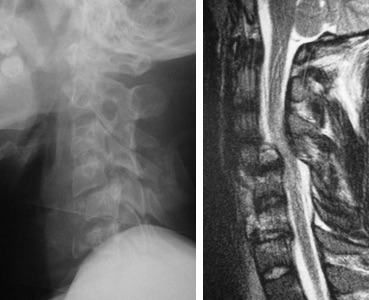
4. An injured vertebral segment may be accompanied with blood clots or ruptured or herniated intervertebral disc in the spinal canal, occupying space that used to belong to the cervical cord. An MRI scan is necessary to exclude such lesions.
5. Dislocation with displaced, fractured or locked apophyseal joints, vertebral fracture or herniated intervertebral disc, could lead to kinking or crushing of the spinal canal.
Non-surgical treatment
Initially, the patient would mainly need mechanical support for the head and neck to avoid further damage to the spinal column. Since most of the neural damage occurs at the time of injury, the caretaker’s duty is to avoid further displacement and to provide a favourable canal for those partially injured to recover.
1. Initial Assessment: If the patient is unconscious, treat him or her as a victim of spinal cord injury until it is found otherwise. Do not try to manipulate the injured neck. Transport the patient in the resting posture and maintain a clean and unobstructed airway.
If examination at the scene of accident is possible, localise the injured level and document the neurological damage. Any preservation of motion and sensation in the extremities or around the perineum will be helpful in monitoring progress and in making surgical decisions. Incomplete cord lesions have a higher chance of regaining some lower limb movement.
2. Splintage: Support the injured neck with a collar or a splint to control pain and prevent further displacement.
3. Imaging: Radiological examination of the cervical spine and skull are mandatory for all patients that are paralysed or unconscious. If MRI is readily available, it is helpful to define the pathology and the extent of spinal cord lesion before planning any definitive treatment.
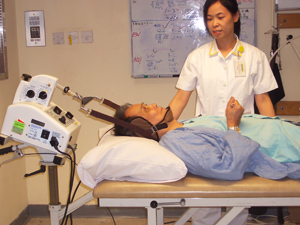
4. Reduction and immobilisation: If subluxation or dislocation of vertebral segments is the only pathology found, conservative treatment with traction may be attempted to reduce the malalignment. Subsequent stabilisation of the cervical segments may either be supportive or surgical.
Surgical treatment
It is mandatory to perform imaging of the spinal canal before attempting a reduction of any spinal subluxation and dislocation. The aim of the surgery is to clear the spinal cord of any anatomical compression, to reduce dislocation and to stabilise the spine curvature. Depending on the nature of the pathology, surgery may need to be done from the front or from the back or a combined approach may be necessary. Sometimes, the use of spinal fixation implants may be called upon.
Rehabilitation
Fusion of the injured vertebral segments is often necessary after an adequate decompression of the injured spinal cord. The neck has to be protected by a neck collar or a more restrictive halo-body brace. Early mobility and ambulation is encouraged. Assisted walking exercises, postural training and muscle strengthening should be started as soon as the neck injury is stabilised. Chest physiotherapy and urological care are part of the rehabilitation programme. Psychological support from the family and team-mates are essential for the patient’s return to society.
Prevention
It is essential to observe precautionary measures in sport. When taking up an unfamiliar movement, guided training should be tailored-made for the athlete. When performing activities such as jumps or somersaults, the neck and head should be well protected. Appropriate guidance and protection should be provided by the coach or trained team-mates.
Dr. MAK, Kan-hing