Introduction
Anatomy
Cause
Symptoms
Diagnosis
Conservative treatment
Surgical treatment
Rehabilitation
Prevention
Introduction
Rotator cuff tears are the most common tendon injury around the shoulder girdle. Most of the patients who suffer from rotator cuff tears are over the age of 40. It is less common to find this injury among younger people but when they do sustain a tear, it often follows an acute trauma or repetitive overhead work or sports activity.
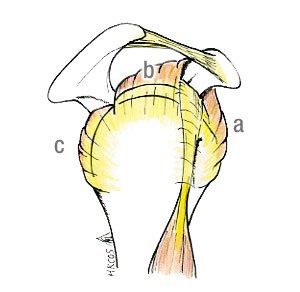
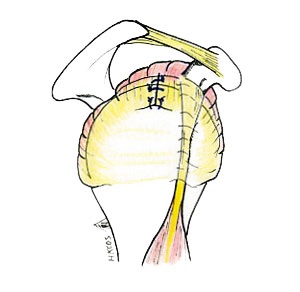
Different types of rotator cuff tear can be identified. Partial rotator cuff tears can be identified either at the bursal or the articular side. Complete rotator cuff tears can take on different sizes, shapes and locations. A tear is regarded “massive” if it is bigger than 5 cm or involves more than two tendons.
Anatomy
The rotator cuff consists of four muscles that immediately wrap around the most cranial part of the proximal humerus, with some of the tendons blending with the gleno-humeral joint capsule. They are attached to the greater tuberosity (lateral part) or lesser tuberosity (anterior part) of the proximal humerus. The rotator cuff helps to hold the humeral head (ball of the shoulder) against the glenoid fossa of the scapula during motion, thereby stabilising the shoulder joint.
Rotator cuff muscles, together with other shoulder girdle muscles, are essential for proper and co-ordinated motion of the gleno-humeral joint (including abduction, adduction, flexion, extension, internal and external rotation) and scapulo-thoracic articulation (including protraction, retraction, elevation, external rotation and internal rotation).
Cause
Rotator cuff tears are a common cause of shoulder pain among adults. This can in turn cause significant disability. Most tears occur in the tendon of the supraspinatus muscle, but other parts of the cuff may also be involved.
There are different causes for rotator cuff tears. The rotator cuff can be torn as a result of a single traumatic injury. Examples include the anterior dislocation of the shoulder joint in adult patients with or without existing rotator cuff problems. Trivial traumas can be a cause too, especially for patients with existing rotator cuff problems. Activities such as lifting “heavy” objects could lead to acute tearing of rotator cuff tendons in patients with existing rotator cuff problems.
On the other hand, rotator cuff tears can be a result of everyday wear and tear, especially as a result of the overuse of muscles and tendons over a long period. People who engage in repetitive overhead movements are at risk for overuse. Therefore patients with rotator cuff tears may report recurrent or persistent shoulder pain for several months, with or without any specific injury that triggered the onset of the shoulder pain.
Symptoms
The pain is usually in the front or lateral side the shoulder joint. Most of the patients with rotator cuff tears complain of pain when performing overhead activities. Female patients may have difficulties in putting on bras, which require extension and internal rotation of the shoulder joint. Sometimes, patients with massive rotator cuff tears may experience “psuedoparalysis”, meaning failure to actively abduct the shoulder joint.
Signs of patients with rotator cuff tears may include:
wasting of the supraspinatus or infraspinatus muscles in the shoulder;
pain upon abduction or elevation of the arm (impingement sign);
pain when lowering the arm from a fully raised position;
weakness upon elevation or external rotation of the arm;
“crepitus” upon moving the shoulder in certain positions.
Onset of these symptoms and signs may be acute – often immediately after a specific trauma or a fall on the affected arm. On the other hand, onset of symptoms may develop gradually as a result of repetitive overhead activities or following long-term wear and tear.
At first, the pain may be mild and only comes with certain activities, say upon elevation of the arm. It can often be relieved by over-the-counter pain killers or rest. Gradually, these symptoms become more and more disturbing, with pain even at rest or without any specific activity at all. At night time, patients may have shoulder pain when lying on the affected side.
Diagnosis
If a patient suspects that he or she has a rotator cuff tear, an orthopaedic surgeon can first take a medical history and perform a detailed physical examination of the shoulder joint to see whether there is a deformity or wasting of muscles. He or she will feel for any particular tender spots, and measure the active and passive range of motion of the shoulder in different planes of motion.
The surgeon will also check for any signs of impingement, weakness and instability of the shoulder joint and any other shoulder problems. Depending on the patient’s conditions, the surgeon may also examine the neck, because shoulder pain may actually be a result of referred pain from cervical spine problems.
Plain X-rays and other specific imaging studies, including MRI (Magnetic Resonance Imaging with or without an arthrogram) or ultrasound, are also helpful. X-rays of the shoulder with complete rotator cuff tear may show minor changes only, such as a small subacromial spur or sclerosis of the greater tuberosity. For this reason, the surgeon may need additional imaging studies, either an ultrasound or MRI, for better assessment and documentation of the soft tissue structures, including rotator cuff tendons. MRI scans can sometimes show signal changes suggesting of tendinosis of the cuff tendons. It can also assess the size, shape and location of the tear, as well as the degree of atrophy of the corresponding cuff muscles. The condition of the biceps tendon can also be assessed.
Conservative treatment
Conservative treatment can provide pain relief and improve the shoulder’s functions.
The options are:
rest and modifications of day-to-day activities;
the use of an arm sling;
medications for pain control;
physiotherapy, including cuff-strengthening exercises;
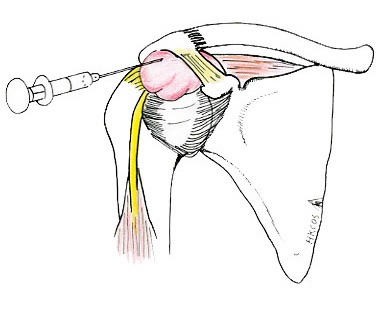
injection into the subacromial space with steroid.
Surgical treatment
Under the following conditions, your orthopaedic surgeon may recommend surgery:
failed conservative treatment with persistent symptoms;
acute rotate cuff tear with severe pain and significant weakness;
tear is in the shoulder of the dominant arm of an active person;
if maximum strength in the arm is needed for overhead work or sports.
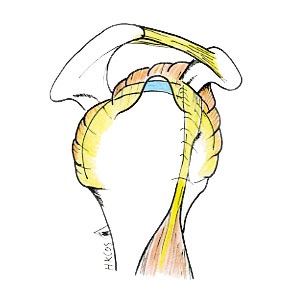
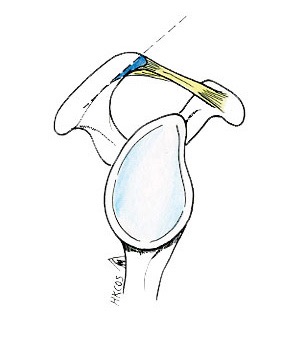
The type of surgery chosen by your orthopaedic surgeon depends on a lot of factors, for example, the size, shape and location of the tear. A “minimal” partial tear may not require any formal repair procedure, and a trimming procedure of the fibrillated tendon fibers is adequate (debridement). A complete tear within the thickest part of the tendon is repaired by suturing the two sides of the tendon back together. If the tendon is torn away from its bony insertion site at the proximal humerus, it is repaired directly back to the bone for healing.
During surgery, your orthopaedic surgeon may remove the anteroinferior part of the acromion (acromioplasty) to tackle the issue of “outlet impingement”. It is because a prominent acromion is thought to cause impingement on the cuff tendons and contribute to tear formation.
Other conditions, such as arthritis of the acromioclavicular joint (ACJ) or tearing of the biceps tendon, may also be addressed in this surgery.
Generally, there are three surgical approaches available for the repair of a torn cuff tendon. These include:
1. Arthroscopic repair
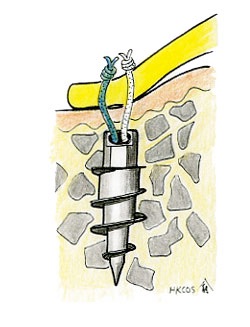
A fiber optic scope and appropriate “pen-like” arthroscopic instruments are inserted through several small incisions. This allows the orthopaedic surgeon to perform appropriate surgical repairs under video control. Special implants, known as suture anchors, are used to reattach the torn tendon back onto the greater tuberosity.
2. Mini-open repair
Newer techniques and instruments allow surgeons to perform a complete rotator cuff repair through a small incision, typically 4 cm to 6 cm.
3. Open surgical repair
A traditional open surgical incision is often required if the tear is large or complex or if additional reconstruction, such as a tendon transfer, has to be done.
In some chronic cases with massive rotator cuff tears and severe retraction of the torn tendon ends, anatomical repair may not be possible. Reconstruction with tendon transfer is a possible option for suitable cases. Simple “debridement” with “tuberoplasty” may provide temporary relief of the symptoms. Your orthopaedic surgeon can provide detailed explanations concerning treatment options for this condition.
In some severe cases of massive rotator cuff tears associated with arthritis of the shoulder joint (cuff arthropathy), one option is to replace the shoulder joint with an artificial joint (arthroplasty).
Rehabilitation
Rehabilitation constitutes an essential component of the whole treatment process. After the surgery, the arm is immobilised to allow the tear to heal. The duration of immobilisation depends on the size and complexity of the tear.
A supervised exercise programme will help regain motion and strength of the shoulder joint while, at the same time, avoiding excessive stress to overload the repaired tendon. Usually, the physical therapy programme begins with gentle and passive motion and, at the appropriate time, advances to active exercises that involve resistance. The programme will be individualised by your orthopaedic surgeon, physiotherapist and occupational therapist based on your conditions.
Complete recovery usually takes several months. A strong commitment to rehabilitation is essential in achieving a good surgical outcome. Your orthopaedic surgeon will assess the final outcome to provide advice on when it is safe to return to overhead work and sports activity.
Prevention
One should seek early medical attention if shoulder pain develops because of overuse
Regular exercise to maintain the range of motion of the shoulder joint can help prevent stiffness.
Dr. YU, Kong-san